
Introduction
Artificial intelligence is changing how people work. It can write emails, analyze documents, answer customer questions, generate software code, translate languages and identify patterns in large amounts of data
That creates a serious question for India: will AI replace jobs by 2030?
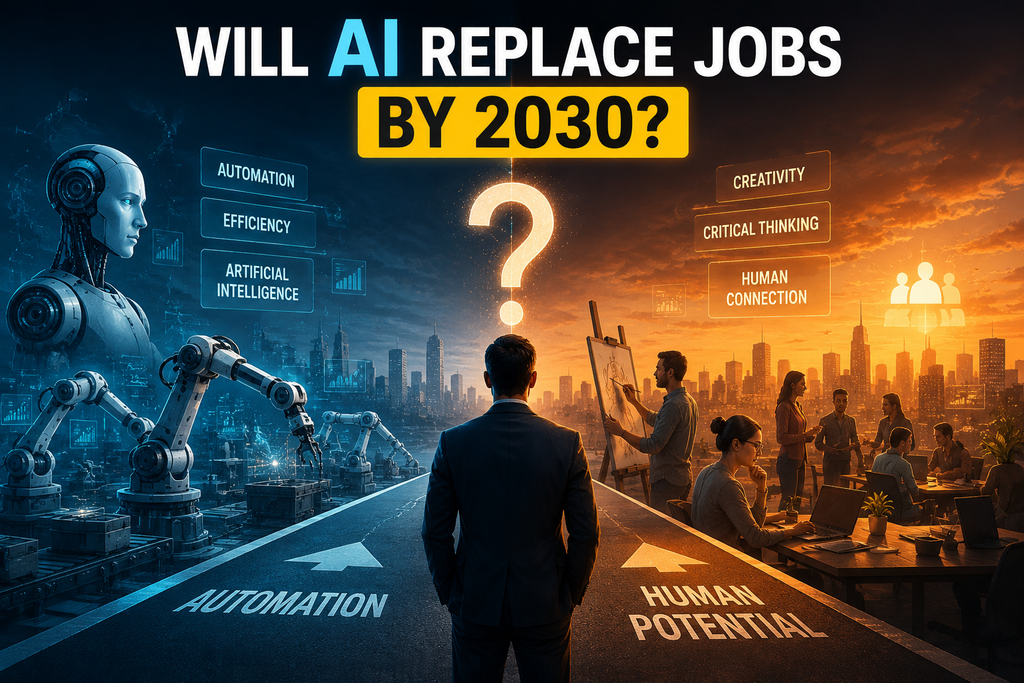
The most accurate answer is neither “yes, all jobs will disappear” nor “no one will be affected.” By 2030, AI is likely to replace some tasks, reduce demand for certain routine roles and transform many existing jobs. At the same time, it will create demand for new skills and new types of work
The important distinction is this: AI may replace parts of a job faster than it replaces an entire profession. A bank employee may use AI to review documents faster, but customers may still need a person for trust, explanation and responsibility. A teacher may use AI to prepare learning materials, but students will still need guidance, motivation and human connection.
What do major reports suggest?
Major labour-market research suggests that AI is likely to transform jobs rather than simply eliminate them. The World Economic Forum’s Future of Jobs Report 2025 remains one of the key quantitative forecasts for the 2030 horizon. It estimates that labour-market transformation could affect around 22% of today’s formal jobs, with approximately 170 million jobs created and 92 million displaced, resulting in a net increase of 78 million jobs by 2030.
The report also highlights that nearly 40% of workers’ core skills are expected to change by 2030. AI, big data, networks and cybersecurity are among the fastest-growing technical skills, while analytical thinking, creative thinking, resilience, leadership and collaboration remain important human capabilities.
The International Labour Organization (ILO) provides another important perspective. Its 2025 research estimates that one in four workers globally are in occupations with some exposure to generative AI. However, only around 3.3% of global employment falls into the highest exposure category. The ILO stresses that exposure to AI does not automatically mean an entire occupation will disappear; in many cases, AI is more likely to change or assist the tasks people perform.
Key Data at a Glance
| Report / Source | Year | Key Finding | What It Means |
| World Economic Forum – Future of Jobs | 2025 | 22% of current formal jobs could be disrupted by 2030 | Significant labour-market transformation is expected |
| WEF | 2025 | 170M jobs created by 2030 | Technology and other global trends can generate new opportunities |
| WEF | 2025 | 92M jobs displaced by 2030 | Some existing roles are likely to decline |
| WEF | 2025 | +78M net jobs by 2030 | Overall job creation could exceed displacement |
| WEF | 2025 | 39% of core skills expected to change | Continuous learning will become increasingly important |
| WEF | 2025 | 41% of employers plan workforce reductions where AI automates tasks | Some workers will face direct displacement |
| WEF | 2025 | 77% of employers plan to upskill workers | Training is expected to be a major response to AI |
| ILO | 2025 | 1 in 4 workers are in occupations with some GenAI exposure | AI can affect tasks without eliminating the whole job |
| ILO | 2025 | 3.3% of global employment is in the highest GenAI exposure category | Full automation potential is much smaller than overall AI exposure |
| WEF | 2026 | 4 plausible AI-and-talent futures explored for 2030 | futures explored for 2030 The outcome depends on AI adoption and workforce adaptation |
| Linkedin data reported by WEF | 2026 | 1.3M new AI-related jobs added globally in two years | AI is already creating new categories of work alongside disruption |
Reference WEF: Click Here
Reference ILO: Click Here
Which jobs are less likely to be fully replaced?
AI is powerful at pattern recognition and information processing, but many jobs involve responsibilities that are difficult to automate completely. Roles are more resilient when they require:
- Human trust and emotional intelligence
- Physical presence in changing environments
- Accountability for important decisions
- Negotiation and relationship-building
- Leadership and team coordination
- Ethical judgment
- Creativity connected to real-world context
- Skilled manual work
- Local language and cultural understanding
Healthcare professionals, teachers, skilled technicians, managers, salespeople, social workers, legal decision-makers and many public-facing officials may use AI extensively without being replaced by it.
Their work will still change. The valuable worker of 2030 may be the person who combines professional knowledge with the ability to use AI accurately and responsibly.
How could affect different sectors in India ?
IT and business services
AI may automate routine coding, testing, documentation, support and data-analysis tasks. However, demand can grow for people who understand business problems, manage AI systems, secure data and verify outputs.
Banking and finance
AI can assist with fraud detection, customer support, risk analysis and document review. Human oversight will remain important because financial decisions involve regulation, trust and potential harm to customers.
Education
AI can help create lesson plans, personalise practice and support language learning. Teachers will remain essential for mentoring, classroom management, assessment and helping students develop judgment
Healthcare
AI may support diagnosis, scheduling, medical records and research. Healthcare workers will still be needed for physical care, communication, ethical decisions and responsibility for patients.
Government and public administration
Government departments may use AI for document processing, citizen-service chatbots, translation, data analysis and identifying irregularities. Employees who understand digital workflows, privacy, public accountability and service delivery will become more valuable.
Manufacturing, agriculture and retail
Automation may improve quality control, inventory management, forecasting and logistics. At the same time, India will continue to need people who can operate, maintain and adapt technology in real-world conditions.
Will AI create new jobs in India?
Yes, but new jobs may not look like traditional occupations. Growing areas could include:
- AI implementation and business automation
- Data quality and data governance
- Cybersecurity and privacy
- AI model testing and evaluation
- Human oversight of automated decisions
- AI-assisted teaching and training
- Workflow design and digital operations
- Robotics maintenance
- Responsible AI and compliance
- Domain experts who can guide AI systems
The strongest opportunities may go to people who combine two abilities: knowledge of a real industry and the practical ability to use AI tools. A healthcare worker who understands AI-supported records may be more valuable than someone who knows AI tools but understands no healthcare context.
What should students and freshers do?
Students do not need to become machine-learning engineers to prepare for the AI economy. They should build a balanced skill set:
1. Learn AI literacy: Understand what AI can do, where it fails and how to check its answers.
2. Develop a core domain: Choose an area such as finance, marketing, design, programming, healthcare or public administration.
3. Improve communication:** Clear writing, speaking, presentation and teamwork remain valuable.
4. Create proof of work: Build projects, case studies, dashboards, research notes or portfolios instead of relying only on certificates.
5. Practice critical thinking: Learn to question outputs, identify bias and make evidence-based decisions.
A fresher who can explain a business problem, use AI to develop a first solution and verify the final result will stand out from someone who merely lists “AI” on a resume.
What should government employees do?
Government employees should focus on skills that make public services more accurate, accessible and accountable. Useful areas include:
- Digital file and workflow management
- Data interpretation
- Cybersecurity awareness
- Privacy and responsible use of citizen data
- Clear communication with the public
- Process improvement
- Supervising automated systems
AI adoption in government should not be judged only by cost reduction. It should also be measured by fairness, transparency, accessibility and the quality of service citizens receive.
What about people who are currently not working?
The AI transition should not be viewed only as a threat. It can lower the barrier to starting small services, learning new subjects and reaching customers. People can use AI to practise English, prepare applications, learn digital tools, create marketing materials or explore home-based business ideas.
However, AI tools do not replace the need for basic digital safety. Avoid sharing sensitive identity, financial or employment information with unknown tools. Verify important information before acting on it, especially in health, finance and government matters.
A practical 90-day preparation plan
Days 1–30: Build foundations
Choose one career or work area. Learn the basic AI tools used in that area, along with privacy and fact-checking practices.
Days 31–60: Apply the skill
Complete a small project. For example, analyse a public dataset, automate a repetitive spreadsheet task, create a customer-service knowledge base or prepare an AI-assisted research report.
Days 61–90: Show your value
Publish the project in a portfolio, explain the problem and results clearly, and ask a teacher, colleague or industry professional for feedback. Then improve it.
This approach is more useful than collecting random AI tools without understanding how they create value.
Final answer: Will AI replace jobs in India by 2030?
AI will replace some tasks and may reduce employment in certain routine roles. It will also transform existing jobs and create new opportunities. The biggest danger is not simply AI itself; it is being unprepared for work that changes around you
India’s future will depend on how quickly workers can reskill, how responsibly organizations adopt AI and whether education and public policy reach people beyond major technology hubs.
For students, freshers, government employees and non-working adults, the practical strategy is clear: build domain knowledge, learn to use AI, strengthen human skills and demonstrate real results.
By 2030, the question may not be “Will AI take my job?” It may be: “Can I become the person who uses AI to do valuable work better?”
FAQ
Will AI cause unemployment in India?
AI may increase unemployment in some routine roles, especially when workers do not receive training. However, it can also create new jobs and improve productivity. The final impact will vary by sector, location, education and policy.
Which jobs are safest from AI in India?
No job is completely unaffected, but roles requiring trust, physical presence, leadership, empathy, accountability and complex judgment are less likely to be fully automated.
Should students learn AI instead of traditional subjects?
No. Students should build strong fundamentals in their chosen field and learn how AI supports that field. AI literacy works best alongside domain knowledge.
Will government jobs be replaced by AI?
Some administrative tasks may become automated, but government services still require human accountability, public communication, ethical judgment and field-level implementation.
Is learning prompt writing enough for an AI career?
Prompt writing can be useful, but it is not enough by itself. Employers are likely to value domain expertise, communication, data awareness, problem-solving and the ability to evaluate AI outputs.
My Conclusion
I literally use over 50 AI tools, and when I heard about ChatGPT, I was surprised because it gave me the type of result that I had hardly achieved. Still, now it create a high quality images which i not create easily using photoshop write a great level of scripts. I have also used other apps in the last 2 years. I know about all things that it can do, but when I go to interview at those 15+ companies, no any singal company use Ai in that work. I cannot say that IT and Metro City can implement AI technologies in that work or business, but it takes some time…
AI is unlikely to replace every job in India by 2030 – but it will change how many jobs are done. The people who prepare early will have an advantage. Read the practical guide for students, freshers, government employees and anyone planning their next career move.
2 thoughts on “Will AI Replace Jobs in India by 2030?”