
Introduction
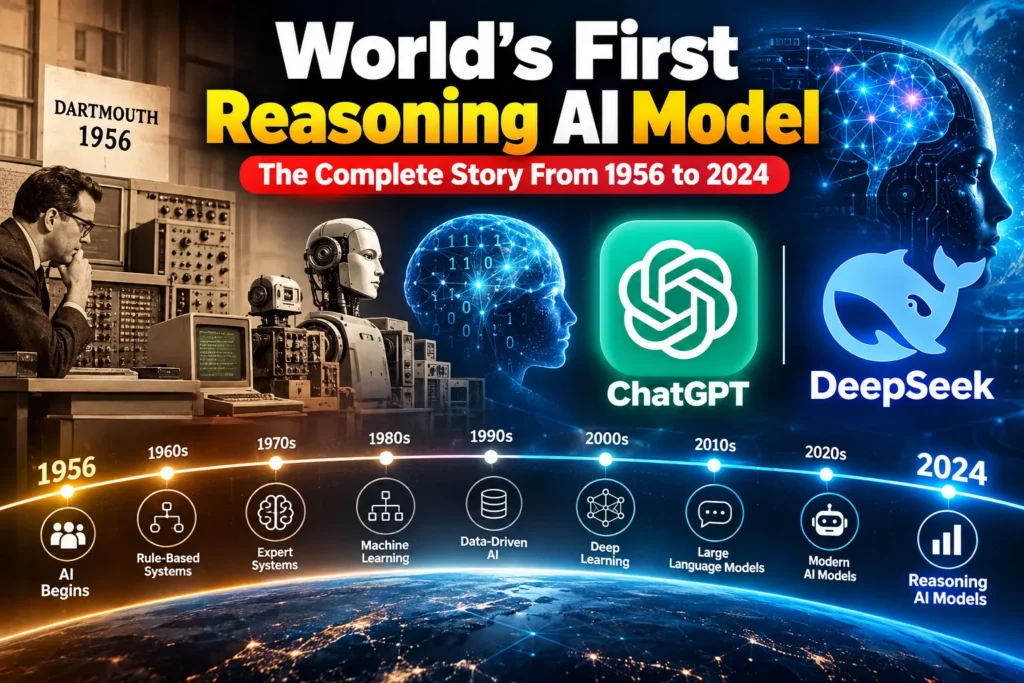
There is one question that keeps coming up in AI discussions lately — which was the world’s first reasoning AI model?
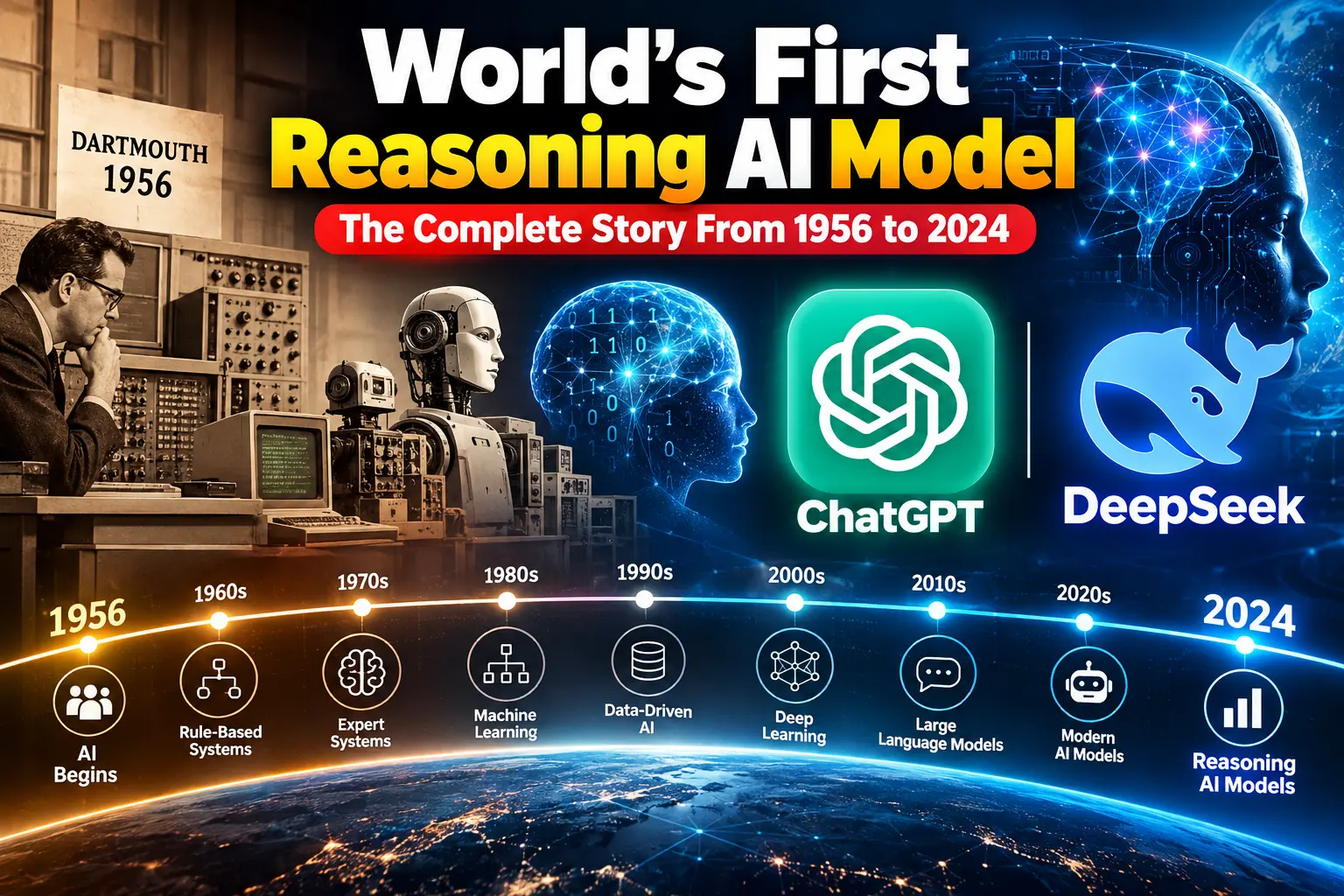
And honestly, it is a question worth digging into. Because depending on how you define “reasoning AI,” the answer changes completely. Some people point to OpenAI’s o1. Some say DeepSeek did it first. And a small group of researchers will quietly remind you that this whole journey started back in 1956 — decades before the internet even existed.
This blog covers the complete truth. We are going to walk through the real history, explain what reasoning in AI actually means, look at the hard evidence behind OpenAI o1 being the modern pioneer, and also answer the burning question — why DeepSeek is not the first, even though it shook the entire tech world.
By the end, you will have a clear, honest understanding of how AI learned to think — not just answer.
What Does “Reasoning” Actually Mean in AI?
Before we talk about which model came first, we need to get one thing straight. What exactly is a “reasoning” AI?
Most AI models you interact with — like older versions of ChatGPT — work ohn a pattern called System 1 thinking. That means they react fast. You type a question, they instantly predict the most probable next word, and keep doing that until an answer is formed. There is no real “thinking” happening — it is sophisticated pattern matching at a massive scale.
Reasoning AI is completely different.
A reasoning AI uses what psychologists call System 2 thinking. It slows down. It breaks a problem into smaller steps. It explores multiple possible paths. It checks its own logic. It corrects itself. And only after going through that internal process does it produce an answer.
Think of it this way:
- A regular AI is like a student who reads the question and immediately writes the first thing that comes to mind.
- A reasoning AI is like a student who reads the question, scratches out some working on rough paper, reconsiders, and then writes the final answer.
That difference — the internal working-out process — is what separates reasoning models from everything that came before them.
Part 1: The Historical First — Logic Theorist (1956)
Who Built It and Why
If we are talking about the very first program ever designed to make a machine reason like a human, the answer goes back to 1956. That year, three researchers at the RAND Corporation — Allen Newell, Herbert A. Simon, and Cliff Shaw — created a program called the Logic Theorist.
Their goal was ambitious and, at the time, borderline revolutionary: build a computer program that could prove mathematical theorems the same way a human mathematician would — by reasoning through them step by step.
Herbert Simon, one of the creators, was not just a computer scientist. He was also a cognitive psychologist and economist who would later win the Nobel Prize. His core belief was that human thinking was essentially a form of symbol manipulation — and if that was true, a machine could do it too.
That belief became Logic Theorist.
What Logic Theorist Could Do
Logic Theorist was designed to prove theorems from Whitehead and Russell’s Principia Mathematica, one of the most important works in the history of mathematical logic. It did not just find answers by brute force — it used heuristic search, meaning it made intelligent guesses about which paths were more likely to lead to a proof, just like a human would.
Here are some key facts about what it achieved:
- It successfully proved 38 out of 52 theorems from Principia Mathematica
- For one particular theorem, it found a proof that was actually shorter and more elegant than the one in the original book
- It demonstrated that a machine could perform non-numerical, logical reasoning — something most scientists at the time believed was impossible
The Rejection That History Will Never Let Go Of
Here is a story that tells you everything about how ahead of its time Logic Theorist was.
Newell and Simon tried to publish Logic Theorist’s new proof of a mathematical theorem in The Journal of Symbolic Logic. The journal rejected it. Their reason? A new proof of an elementary theorem was not notable enough to publish.
They apparently overlooked the fact that one of the co-authors of that proof was a computer program.
History, of course, proved them very wrong.
Logic Theorist was officially presented at the Dartmouth Conference in 1956, which is widely considered the founding moment of artificial intelligence as a field. It was not just the first reasoning AI program — it was arguably the spark that started the entire discipline of AI research.
Part 2: The Modern Revolution — OpenAI o1 (September 2024)
The Gap Between 1956 and 2024
Between Logic Theorist and OpenAI o1, there were decades of AI research. Expert systems in the 1970s and 80s tried to encode human knowledge in rules. Neural networks rose and fell and rose again. Deep learning transformed image recognition, speech processing, and eventually language.
And then came large language models — GPT-3, GPT-4, Claude, Gemini. These were genuinely impressive. But they still had a fundamental limitation. They were fast thinkers, not deep thinkers. They generated fluent, confident answers without actually reasoning through problems.
That changed on September 12, 2024.
What OpenAI o1 Changed Forever
On that date, OpenAI released o1-preview — the first model in their new “o” series — along with o1-mini. The full version of o1 followed on December 5, 2024.
OpenAI called it something they had never called any model before: a reasoning model.
And they meant it technically, not just as marketing. OpenAI o1 was trained using large-scale reinforcement learning specifically designed to produce a chain of thought — an internal reasoning process — before generating any output. The model was not just predicting the next word. It was working through problems, step by step, before committing to an answer.
This was a fundamentally new approach to how an AI model operates.
How OpenAI o1 Actually Works
Understanding the technical difference between o1 and earlier models matters here.
Every AI model before o1 relied almost entirely on what is called pre-training compute. You make the model bigger. You give it more data. You train it longer. That is how you make it smarter.
o1 introduced something different — inference-time compute. Instead of just spending more resources at training time, you give the model extra computation at the moment it is answering a question. That extra computation is used to reason — to explore different approaches, evaluate them, and choose the best path forward.
This means even a smaller o1 model can outperform a larger non-reasoning model on complex problems, simply because it is thinking more carefully rather than just reacting faster.
The Benchmark Numbers That Shocked Everyone
When o1 launched, OpenAI shared its performance on standardized tests — and the results were hard to believe at first.
On the 2024 AIME exam, which is a national math competition for elite high school students in the United States:
- GPT-4o managed to solve only 12% of problems
- o1 solved 74% with a single attempt
- o1 solved 83% when given 64 attempts and consensus was used
- o1 solved 93% when allowed to refine across 1,000 samples
On competitive programming challenges on Codeforces, o1 ranked in the 89th percentile — meaning it performed better than 89 out of every 100 human competitors.
On GPQA, a benchmark that tests PhD-level knowledge in physics, biology, and chemistry, o1 exceeded human PhD-level accuracy.
These were not incremental improvements. They were a category shift.
The DeepSeek Question: Why It Is Not the First
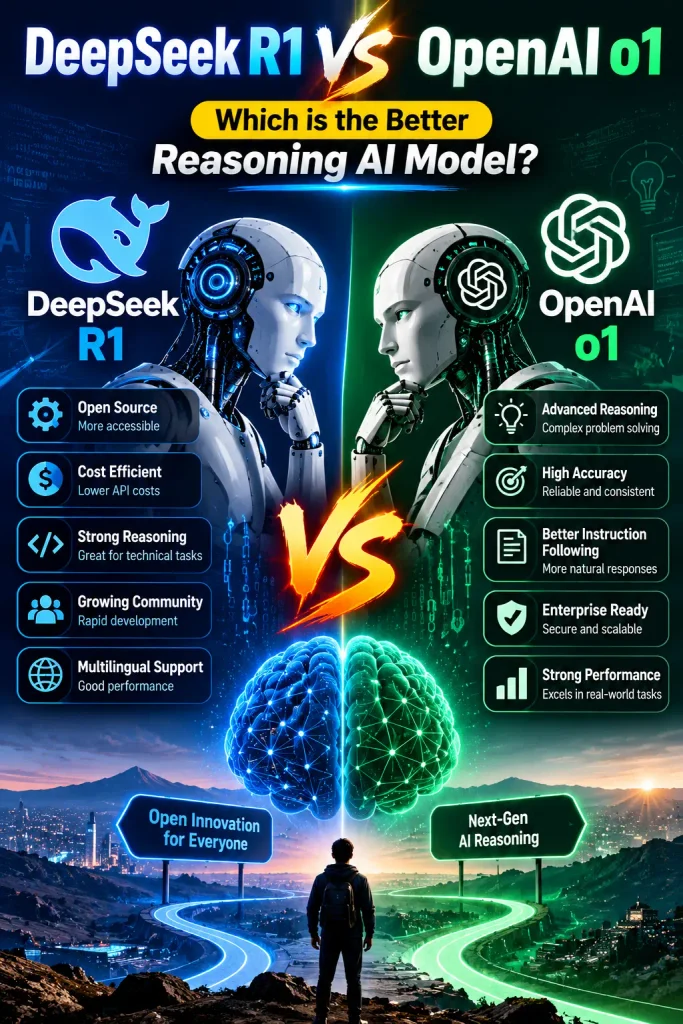
A lot of people assume DeepSeek invented reasoning AI. This confusion is understandable — DeepSeek R1 was so viral, so disruptive, and so widely covered that it felt like a moment of invention. But the timeline tells a different story.
The Exact Dates Matter
- OpenAI o1-preview launched: September 12, 2024
- DeepSeek R1-Lite-Preview launched: November 20, 2024
- DeepSeek R1 full release: January 20, 2025
That is a four-month gap. OpenAI introduced the concept of a modern reasoning LLM nearly half a year before DeepSeek’s full release.
So Why Did DeepSeek Feel Like a Revolution?
Because in its own way, it was. Just not the revolution people think.
Here is what DeepSeek actually did that was genuinely groundbreaking:
- It matched o1’s performance for a fraction of the cost — reportedly under $6 million to train
- It was open-source, meaning anyone could download and run it
- It proved that closed, expensive AI was not the only path to frontier-level reasoning
- It shocked Silicon Valley so much that Nvidia’s stock dropped by up to 18% in a single day — the largest single-day market cap loss in US history at that point
DeepSeek did not invent reasoning AI. What it did was democratize it. And that distinction is important.
A useful comparison: Jio did not invent mobile internet in India. But it made mobile internet available to everyone at a price that changed the country. That is exactly what DeepSeek did for reasoning AI on a global scale.
Reasoning AI Models: Timeline at a Glance
- 1956 — Logic Theorist is created by Newell, Simon, and Shaw. First ever program built to reason. Presented at Dartmouth Conference.
- 2017 — Google Brain publishes the “Attention is All You Need” paper, laying the foundation for modern transformer-based LLMs.
- 2022 — ChatGPT launches and brings AI into mainstream culture, but still uses System 1 style response generation.
- September 2024 — OpenAI launches o1-preview. First modern reasoning LLM using chain-of-thought and reinforcement learning.
- November 2024 — DeepSeek releases R1-Lite-Preview. First open-source attempt at a reasoning model.
- January 2025 — DeepSeek R1 full release. Open-source reasoning model that matches o1 at dramatically lower cost.
- February 2025 — Claude 3.7 Sonnet releases as the first hybrid reasoning model, capable of both fast and extended reasoning.
- 2025 onward — Reasoning models become the new standard across the industry.
Why Reasoning AI Is a Bigger Deal Than Most People Realize
Here is something worth sitting with for a moment.
For nearly 70 years after Logic Theorist, AI systems either reasoned in narrow symbolic ways or reacted quickly through pattern matching. No one had built a general-purpose model that could reason deeply, across domains, in natural language, at scale.
OpenAI o1 crossed that line.
And what comes after reasoning models is even more significant. When an AI can genuinely think through problems, it becomes capable of:
- Solving novel scientific problems that were never in its training data
- Writing complex, multi-step code without common logical errors
- Performing at expert level in fields like medicine, law, and mathematics
- Identifying flaws in its own reasoning and self-correcting
This is why the release of o1 is considered one of the most significant events in AI history — not just an upgrade, but a paradigm shift in what AI is fundamentally doing when it produces an answer.
FAQs: World’s First Reasoning AI Model
Q1. What is the world’s first reasoning AI model?
There are two answers depending on the era. Historically, the Logic Theorist (1956) built by Allen Newell, Herbert Simon, and Cliff Shaw was the first program ever designed to reason like a human. In the modern LLM era, OpenAI o1 — released as o1-preview on September 12, 2024 — was the first large language model built specifically with chain-of-thought reasoning using reinforcement learning.
Q2. Is DeepSeek the first reasoning AI model?
No. DeepSeek R1 was released on January 20, 2025, which is approximately four months after OpenAI launched o1-preview in September 2024. DeepSeek is historically significant for being open-source and cost-efficient, but it did not originate the concept of reasoning models.
Q3. What is the difference between a reasoning AI model and a regular AI model?
A regular AI model generates responses using fast, pattern-based prediction — often called System 1 thinking. A reasoning AI model uses System 2 thinking, where it works through problems step by step, explores multiple approaches, and checks its own logic before producing a final answer.
Q4. How does OpenAI o1 reason?
OpenAI o1 is trained using large-scale reinforcement learning to generate an internal chain of thought before responding. It also uses inference-time compute, meaning it is given extra processing time at the moment of answering, allowing it to think more carefully rather than simply reacting.
Q5. What were the benchmark scores of OpenAI o1?
On the 2024 AIME math exam, o1 scored 74% with a single attempt and up to 93% with repeated sampling. It ranked in the 89th percentile on Codeforces competitive programming and exceeded human PhD-level accuracy on the GPQA science benchmark.
Q6. What made Logic Theorist significant in 1956?
Logic Theorist was the first computer program that proved mathematical theorems using reasoning rather than brute force. It successfully proved 38 out of 52 theorems from Principia Mathematica and in one case found a shorter proof than the original. It was presented at the Dartmouth Conference, the founding event of AI as a research field.
Q7. Why did DeepSeek cause such a massive reaction despite not being first?
DeepSeek R1 was open-source and reportedly trained for less than $6 million — a tiny fraction of what US companies spend on comparable models. It matched OpenAI o1’s performance on multiple benchmarks while being freely available. This disrupted the assumption that frontier AI required enormous budgets, leading to widespread industry panic and a historic drop in Nvidia’s stock price.
Q8. Are reasoning AI models the future?
By all indications, yes. As of 2025, virtually every major AI lab — OpenAI, Anthropic, Google, Meta, and DeepSeek — has shifted toward reasoning-capable models. The ability to think before answering is now considered a core requirement for frontier AI, not an optional feature.
Conclusion
The story of reasoning AI is not a simple one-line answer. It stretches from a room full of researchers at the RAND Corporation in 1956 to the server farms of San Francisco and Shenzhen in 2024.
Logic Theorist gave us proof that machines could reason. Decades of research in neural networks, deep learning, and language modeling built the infrastructure for what came next. And then OpenAI o1 arrived — quietly, without the fanfare of some releases — and permanently changed what we expect from AI.
DeepSeek, for its part, made sure that reasoning AI would not stay locked behind paywalls and proprietary systems. That is a contribution worth acknowledging even if it does not come with the “first” label.
What matters now is where this goes. Because once an AI can genuinely reason — once it can think through a problem the way a careful human expert would — the limits of what AI can accomplish shift dramatically. We are only at the beginning of understanding what that means.
Sources: OpenAI o1 System Card (arXiv:2412.16720), Wikipedia — Logic Theorist, Wikipedia — OpenAI o1, Wikipedia — Reasoning model, IISS Strategic Comments on DeepSeek R1, DataCamp DeepSeek R1 Analysis