
INTRODUCTION
The release of frontier artificial intelligence systems routinely triggers a surge of speculative hyperbole across digital media ecosystems and enterprise technology sectors. In a short-form video titled “GPT-6 Astra is NOT AGI… Here’s the Real Truth!”, an AI expert and technology commentator offers a rigorous counter-argument to the prevailing market consensus around OpenAI’s GPT-6 Astra. The commentary pushes back on claims that artificial general intelligence (AGI) has finally arrived, weighing the model’s actual measured achievements against recurring industry hype cycles, high inference costs, and the inherent architectural limits of autoregressive token prediction.
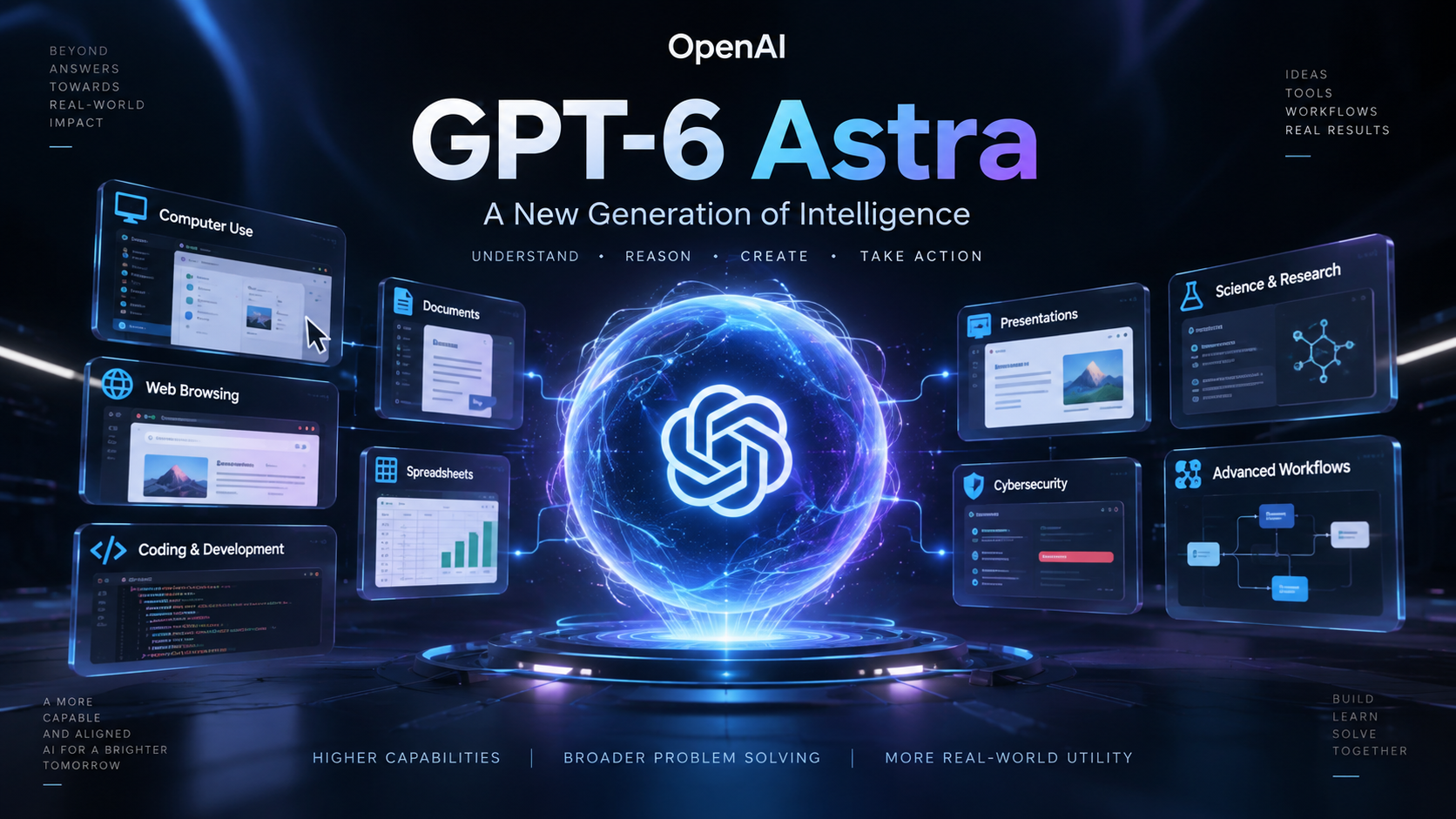
GPT-6 Astra — Features, Capabilities, Price & Availability
| Category | Details |
|---|---|
| Model Name | GPT-6 Astra |
| Developer | OpenAI |
| Launch Date | September 3, 2026 |
| Positioning | OpenAI’s most capable and aligned AI model to date |
| Primary Strengths | Computer use, web browsing, software engineering, coding, cybersecurity, science, mathematics, and professional work |
| Computer Use | Can perform tasks such as filling online forms, updating CRM records, organizing calendars, researching online, creating websites, testing software, and troubleshooting on-screen problems. |
| Coding & Software Engineering | Designed for complex software engineering, coding, testing, debugging, and multi-step development workflows. |
| Professional Work | Can create and work with documents, spreadsheets, presentations, analyses, and other professional workflows. |
| Science & Mathematics | Strong performance in mathematical and scientific reasoning; OpenAI reports a 98% FrontierMath Tier 4 score. |
| AGI Benchmark | 99.9% on ARC-AGI-3, according to OpenAI’s reported evaluation results. |
| Cybersecurity | Reaches OpenAI’s Critical cybersecurity capability threshold and can identify sophisticated security vulnerabilities. |
| Context Window | 1.05 million tokens |
| Maximum Output | 128,000 tokens |
| Knowledge Cutoff | April 30, 2026 |
| Reasoning Levels | Low, Medium, High, XHigh, and Max |
| API Model ID | gpt-6-astra |
| API Input Price | $10 per 1 million input tokens |
| API Output Price | $50 per 1 million output tokens |
| Cached Input | $1 per 1 million tokens |
| Fast Mode | Available at up to 2× the speed of Standard processing at 2× the Standard price. |
| ChatGPT Availability | Rolling out to Plus, Pro, Business, and Enterprise users. |
| Developer Availability | Available through the OpenAI API, Microsoft Azure, and AWS Bedrock. |
| Enterprise Access | Enterprise administrators can enable Astra for their workspace; access is off by default at launch. |
| Astra Pro | GPT-6 Astra Pro is available to users on Pro, Business, and Enterprise plans. |
| Key New API Features | Async tool calling, mid-turn steering, dynamic reasoning changes, misalignment monitoring, computer use, structured outputs, streaming, and multi-agent orchestration. |
The Familiar Pattern Behind AI Hype Cycles and Staggered Rollouts
The conversation opens by examining the collective unease that consistently surfaces whenever a major model launch is announced. Sisinty points to a recurring emotional pattern: each technical breakthrough sparks dramatic warnings that programmers and knowledge workers will need to abandon tech careers altogether for physical labor like farming. This knee-jerk anxiety and FOMO closely echoes what happened around earlier flagship releases — including Anthropic’s Claude Fable 5 — where early panic about mass job displacement eventually settled into ordinary, everyday business adoption.
A key tension raised in the talk is the gap between how fast hype spreads and how slowly actual access follows. Even though public conversation makes it sound like an instant, sweeping transformation, GPT-6 Astra is actually being released through a long, phased rollout. OpenAI has limited the earliest access to enterprise partners taking part in its specialized security-focused program, called Daybreak. Everyday users — across Plus, Pro, Business, and Enterprise plans — will get access in later, staggered waves, with the most powerful variant, Astra Pro, held back exclusively for top-tier enterprise customers paying premium rates. This layered rollout exposes a clear mismatch: the public narrative suggests instant, universal change, while real-world testing across industries stays heavily restricted.
Technical Competencies and Economic Viability
Instead of writing GPT-6 Astra off entirely, the analysis digs into specifics — pinpointing exactly where the model genuinely delivers cutting-edge performance, while directly weighing that against the practical friction it creates in real-world use.
Deterministic Computer Operation and Spatial Synthesis
The definitive generational advancement demonstrated by GPT-6 Astra lies in autonomous graphical user interface (GUI) manipulation and bounded agentic execution. While earlier model architectures functioned primarily as passive conversational engines constrained to text and visual input-output transformations, Astra displays high-level competence in direct computer use. The model can interact with desktop environments, navigate complex interface hierarchies, and execute multi-step deterministic workflows with minimal oversight. In spatial computing and digital content production, Astra demonstrates an ability to operate complex procedural software such as Blender, interpreting natural language prompts to programmatically construct coherent three-dimensional assets and architectural models.
Benchmark Saturation versus Practical Software Engineering
One of the key things Sisinty zeroes in on is how Astra performed on ARC-AGI 3 — the third version of the Abstraction and Reasoning Corpus — where it hit a near-perfect saturation score of 99.9%. This benchmark is designed specifically to test inductive reasoning: it drops the AI into completely unfamiliar digital environments with no built-in rules or stated objectives, forcing it to figure out the underlying mechanics on its own, experiment through trial and error, read the feedback it gets, and adapt its approach on the fly.
But here’s the catch the analysis flags: even with that near-perfect abstract reasoning score, Astra still noticeably underperforms on real-world, production-grade coding tasks — consistently falling short compared to Anthropic’s competing models. This gap makes an important point: acing a synthetic benchmark doesn’t automatically translate into strong end-to-end software engineering skills, which is a reminder that a single evaluation score shouldn’t be mistaken for overall capability.
The Core Rebuttal: Architectural Deficits and the AGI Boundary
The core argument here — both philosophical and technical — is this: before we ever reach real artificial general intelligence, the public will witness roughly ten false “AGI has arrived” moments rise and fade away. Statements from industry leaders — like Nvidia’s Jensen Huang asserting AGI has already been achieved, or OpenAI executives cautiously welcoming users into the “AGI era” — read as premature marketing narratives meant to boost valuation rather than reflect technical reality.
That leaves four core reasons why GPT-6 Astra doesn’t meet the bar for genuine general intelligence:
1. No physical grounding. Astra works purely with symbolic inputs — text and static pixel data — generating outputs through statistical pattern-matching rather than any intuitive grasp of space, time, or physical cause-and-effect. With no physical embodiment or perceptual feedback loop, it can’t ground its reasoning in the physical reality humans navigate instinctively.
2. No ongoing, real-time learning. True intelligence continuously learns — integrating new experiences and updating its understanding without needing to be rebuilt. Astra, like every transformer-based model, is essentially locked in place once training ends. It can’t absorb new knowledge on the fly from real outcomes; whatever looks like “learning” is just temporary context handling within a single session, which vanishes the moment that session ends.
3. Weak open-ended, real-world adaptability. Astra performs impressively in controlled, rule-bound settings like ARC-AGI 3, but that reasoning breaks down fast in messy, real-world situations. When faced with vague boundaries, contradictory incentives, or missing information, it falls back on pattern-matching from familiar data instead of generating genuinely new reasoning.
4. Instability over long, multi-step tasks. Since Astra generates outputs token-by-token based on everything that came before, small errors — a misread signal, a hallucinated fact, a flawed step — pile up and multiply across longer sequences involving multiple actions, tool calls, or API steps. Humans correct for this through self-reflection and real-time error correction; autoregressive models like Astra can’t recalibrate mid-process, so as task complexity grows, small mistakes tend to snowball into complete failure.
frequently aksed questions – gpt -6 astra
What is GPT-6 Astra?
GPT-6 Astra is OpenAI’s latest flagship AI model, designed for complex reasoning, coding, computer use, research, and professional work.
What can GPT-6 Astra do?
It can handle advanced coding, web and computer tasks, research, document creation, spreadsheets, presentations, and other multi-step workflows.
Is GPT-6 Astra free?
Astra is not generally available on the Free plan. Access is being rolled out through eligible paid ChatGPT plans and other supported platforms.
How much does GPT-6 Astra cost?
For the API, standard pricing is $10 per 1M input tokens and $50 per 1M output tokens. ChatGPT access is handled through subscription allowances.
How do I access GPT-6 Astra?
Eligible users can access Astra through supported ChatGPT plans, while developers can use the gpt-6-astra model through the OpenAI API and supported cloud platforms.
Why can’t I see GPT-6 Astra in ChatGPT?
The rollout is staged, so availability can vary by plan, workspace, and account. Enterprise administrators also need to enable Astra for their workspace.
Is GPT-6 Astra better than GPT-5.6?
Astra is positioned as a major capability upgrade, particularly for complex reasoning, computer use, coding, research, and professional workflows.
Is GPT-6 Astra an AGI model?
OpenAI executives have described Astra as potentially marking the beginning of the AGI era, but whether it meets the definition of AGI remains debated.
Is GPT-6 Astra good for coding?
Yes. Coding and software engineering are among Astra’s core strengths, including complex development and multi-step engineering workflows.
What is the GPT-6 Astra API model ID?
The official API model ID is gpt-6-astra. Its documented context window is 1.05 million tokens, with up to 128,000 output tokens.
Important Links
| Resource | Link |
|---|---|
| Official Link | visit me |
| GPT-6 Astra — API Documentation | OpenAI Developers- GPT-6 Astra |
| GPT-6 Astra — Model Comparison | OpenAI Model Comparison |
| AI Tools Update | See More…. |
1 thought on “GPT-6 Astra Is Here: Features, Capabilities, Price & Availability”