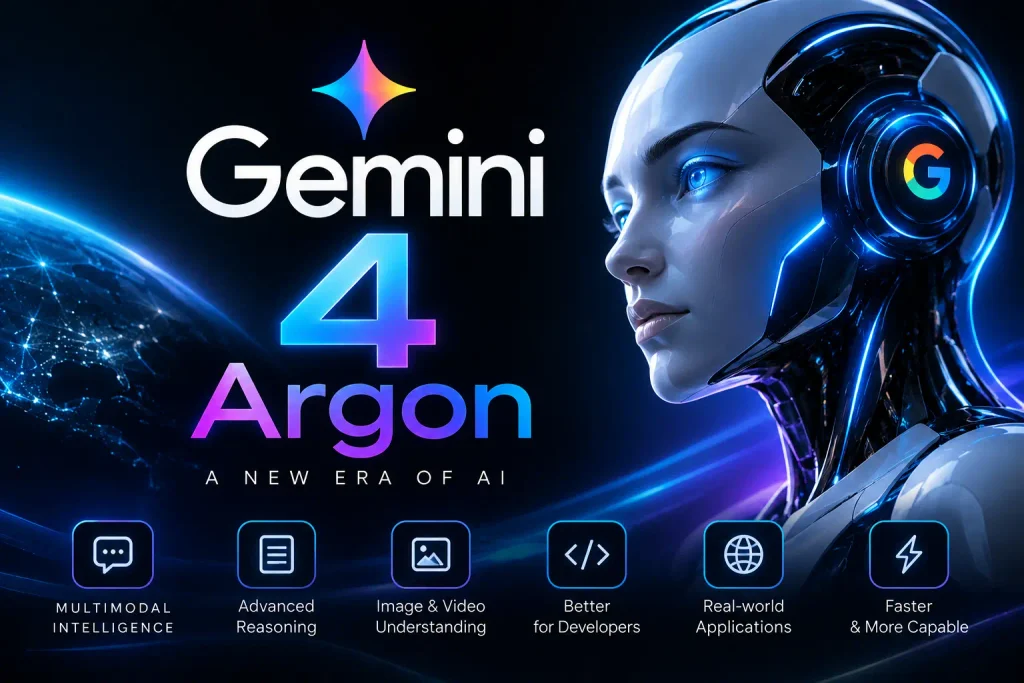

Key Takeaways (Quick Summary)
- Frontier Reasoning Model: Google Gemini 4 Argon (
gemini-4-argon) is Google DeepMind’s flagship frontier model, built on a large-scale Sparse Mixture-of-Experts (MoE) architecture for deep reasoning, software engineering, and enterprise cybersecurity. - Unified 1-Million-Token Context & Output: Breaks the previous 64,000-token output ceiling by supporting up to 1 million tokens for both input and output in a single pass—enabling entire codebase migrations and exhaustive technical reports without truncation.
- Industry-Leading Coding Benchmarks: Ranks #1 across major coding evaluations, achieving 77.9% on DeepSWE v1.1, 91.9% on Vibe Code Bench v1.1, and a 100% score on the International Olympiad in Informatics (IOI) benchmark, outperforming Claude Opus 5.5 and GPT-6 Astra.
- Unmatched Cybersecurity Resilience: Tested under Google’s Fairwind Program, it holds a record-low 0.7% Attack Success Rate (ASR) against indirect prompt injection attacks.
- Flexible Developer Access & Pricing: Available via the Gemini Web App (Paid tier / Google AI Ultra), Google AI Studio, Vertex AI, and Google Antigravity, priced at $2.00 per 1M input tokens and $10.00 per 1M output tokens (with a 95% discount on cached inputs).
Complete Guide to Google Gemini 4 Argon
The artificial intelligence landscape has reached a major inflection point with the launch of Google Gemini 4 Argon. Whether you are a software engineer, a mobile application developer, a cybersecurity analyst, or a technical writer, you have likely seen developers searching for what is gemini 4 argon and how to get gemini 4 argon to modernize their production workflows.
Moving beyond conversational chatbots, Google Gemini 4 Argon is designed to operate as an autonomous software architect and long-horizon reasoning engine. This comprehensive guide covers the model’s core architecture, real-world coding benchmarks, enterprise case studies, API pricing, and step-by-step instructions on how to access it today.
What is Gemini 4 Argon?

To directly answer the question—what is gemini 4 argon?—it is Google DeepMind’s flagship frontier reasoning model, officially released on September 30, 2026. Built from the ground up using a Sparse Mixture-of-Experts (MoE) transformer architecture, Google Gemini 4 Argon processes text, code, images, audio, and video natively while sustaining deep, multi-step reasoning over massive context windows.
Historically, large language models could read hundreds of thousands of tokens of input, but their output generation was capped at 64,000 tokens. When tasked with refactoring an entire application or writing a complete backend API suite, older models would stop mid-generation. Google Gemini 4 Argon eliminates this bottleneck by introducing a unified 1-million-token context and output window, allowing it to think through complex logic and output hundreds of thousands of lines of structured code or documentation in a single execution run.
Top Features of Google Gemini 4 Argon

1. 1-Million-Token Long Decode Capability
By using the Interactions API with background=True and configuring max_output_tokens above 65,536, developers can unlock continuous generation up to 1 million tokens. This transforms how engineering teams handle multi-file diffs, database schema migrations, and comprehensive test suite generation.
2. Controllable thinking_level Parameter
Not every prompt requires maximum compute. Google Gemini 4 Argon gives developers granular control over latency and reasoning depth through the thinking_level parameter:
low: Optimized for fast responses, routine code completion, and straightforward data formatting.medium: Balanced reasoning for multi-file debugging, API design, and technical content creation.high: Maximum deep-thinking allocation for complex system architecture, mathematical proofs, and root-cause vulnerability analysis.
3. Enterprise-Grade Cybersecurity (Fairwind Program)
Trained and stress-tested alongside global cyber defenders through Google’s Fairwind Program, Google Gemini 4 Argon is built for defensive cybersecurity workflows, automated code auditing, and vulnerability patching. In red-team evaluations measuring resistance to indirect prompt injections, Argon achieved a 0.7% Attack Success Rate (ASR)—making it the most resilient frontier model for enterprise deployment.
Benchmark Comparison: Google Gemini 4 Argon vs. Competitors
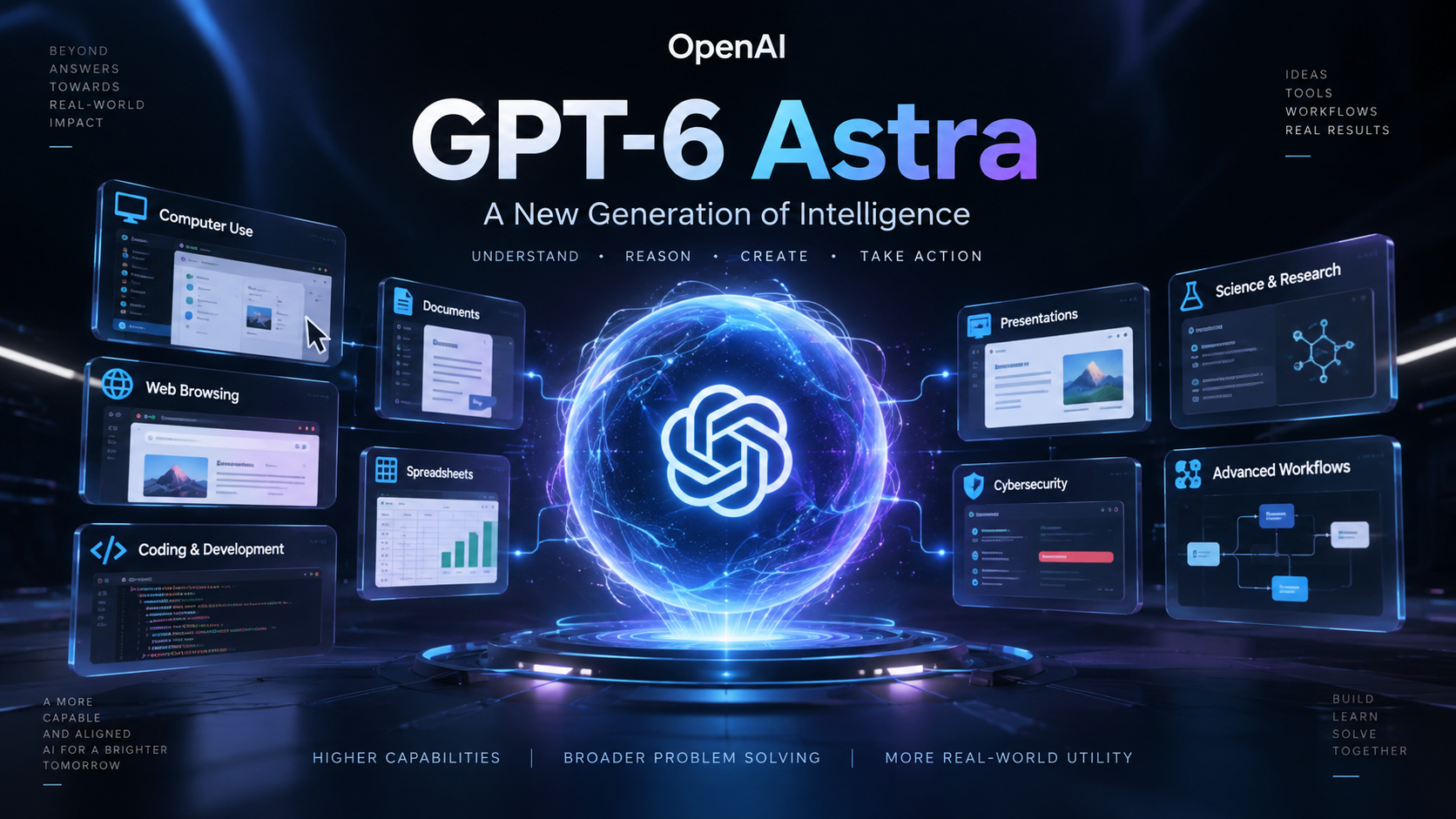
To understand why engineering teams are rapidly adopting Google Gemini 4 Argon, look at how it performs against its closest frontier competitors—Claude Opus 5.5 and GPT-6 Astra—across industry-standard coding and security benchmarks:
| Benchmark / Capability | Google Gemini 4 Argon | Claude Opus 5.5 (Anthropic) | GPT-6 Astra (OpenAI) | Category Winner |
|---|---|---|---|---|
| Max Output Token Capacity | 1,000,000 Tokens (1M) | 128,000 Tokens (128K) | 200,000 Tokens (200K) | Google Gemini 4 Argon |
| DeepSWE v1.1 (Real-World Software Engineering) | 77.9% | 74.2% | 75.5% | Google Gemini 4 Argon |
| Vibe Code Bench v1.1 (Full-Stack App Development) | 91.9% | 88.4% | 89.7% | Google Gemini 4 Argon |
| IOI Benchmark (Algorithmic Competitive Coding) | 100.0% | 92.0% | 94.5% | Google Gemini 4 Argon |
| Indirect Prompt Injection ASR (Lower is More Secure) | 0.7% | 3.8% | 4.2% | Google Gemini 4 Argon |
Real-World Case Study: Migrating 800,000+ Lines of Legacy C/C++ to Rust
One of the clearest demonstrations of what is gemini 4 argon capable of in production comes from an internal Google engineering case study conducted prior to launch.
The Challenge
Memory-safety vulnerabilities in legacy C and C++ libraries represent one of the highest security risks in modern software infrastructure. Google’s internal systems team needed to migrate a complex, production-critical codebase containing over 800,000 lines of C and C++ code into memory-safe Rust. Using previous-generation models with 64K output limits required breaking the repository into hundreds of disconnected chunks, which frequently broke cross-file dependencies, type definitions, and build pipelines.
The Solution with Google Gemini 4 Argon
By leveraging Google Gemini 4 Argon inside an agentic sandbox with its unified 1-million-token window and thinking_level="high", the engineering team fed entire module dependency trees into the model at once. Argon analyzed the memory pointers, refactored the C/C++ logic into idiomatic Rust, generated comprehensive unit and integration tests, and verified compilation across the repository.
The Results
- Single-Pass Module Refactoring: Eliminated context fragmentation across interdependent files.
- Memory-Safe Verification: Successfully translated over 800,000 lines of legacy code while passing strict Rust compiler (
borrow checker) and automated regression test suites. - Drastic Reduction in Engineering Hours: What previously required months of manual refactoring and dependency mapping was compressed into automated, verifiable multi-step agent runs.
How to Get Gemini 4 Argon (Step-by-Step Access Guide)
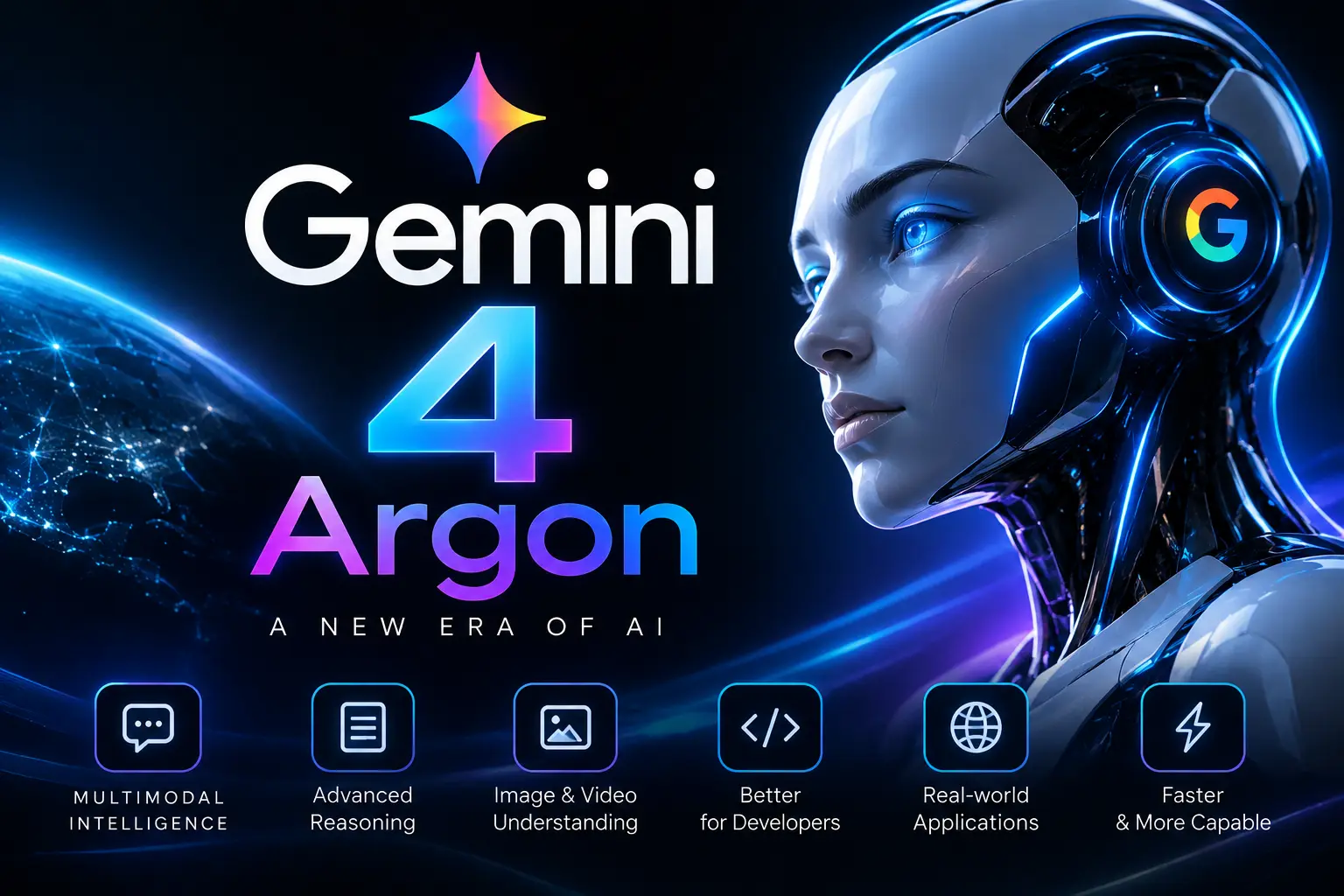
If you are wondering how to get gemini 4 argon for your own development projects, blog research, or enterprise applications, you can access the model through four official channels:
1. Gemini Web Application (Paid Tier & Google AI Ultra)
Individual subscribers on the Gemini Paid tier or Google AI Ultra plan can access the model immediately without writing code:
- Open the official Gemini web interface.
- Click the model selector dropdown menu in the top corner.
- Select Gemini 4 Argon to enable extended deep reasoning and long-output generation.
2. Google AI Studio & Gemini API (For Developers)
Developers building custom applications can call the gemini-4-argon model directly via the Paid tier in Google AI Studio:
- Sign in to Google AI Studio and generate an API key linked to a billing-enabled project.
- Install the official Google GenAI SDK (
pip install google-genai). - Initialize the
gemini-4-argonmodel in your Python or Node.js environment:
from google import genai
from google.genai import types

# Initialize the Gemini API client
client = genai.Client()

# Call Google Gemini 4 Argon with high reasoning depth
response = client.models.generate_content(
    model="gemini-4-argon",
    contents="Design a secure REST API authentication architecture with MySQL schema and rate limiting.",
    config=types.GenerateContentConfig(
        thinking_config=types.ThinkingConfig(thinking_level="high")
    )
)

print(response.text)
3. Google Antigravity Platform
Subscribers to Google AI Ultra can access Google Gemini 4 Argon inside Google Antigravity—Google’s agent-first software development environment featuring hosted execution sandboxes and native Model Context Protocol (MCP) tool integrations.
4. Google Cloud Vertex AI & OpenRouter
Enterprise engineering teams can provision Google Gemini 4 Argon with full IAM governance and SLA support through Google Cloud Vertex AI, or route multi-model API workflows via OpenRouter using the model identifier google/gemini-4-argon.
Google Gemini 4 Argon API Pricing
Google has structured the API pricing for Google Gemini 4 Argon to make large-scale context caching and long-horizon coding highly cost-effective for developers:
| Usage Tier | Price per 1 Million Tokens | Key Notes |
|---|---|---|
| Input Tokens | $2.00 | Applies to standard text, code, and multimodal inputs |
| Output Tokens | $10.00 | Includes generated reasoning and final output tokens |
| Cached Input Tokens | $0.10 | 95% discount off standard input pricing for repeated codebase context |
Frequently Asked Questions (FAQs)
Q1: What is Gemini 4 Argon used for?
Google Gemini 4 Argon is primarily used for complex, multi-step software engineering, full-scale codebase refactoring, defensive cybersecurity auditing, financial/legal document synthesis, and long-horizon autonomous agent workflows.
Q2: How to get Gemini 4 Argon for free?
Currently, Google Gemini 4 Argon is a frontier model available exclusively on paid tiers—including the Gemini Web Paid plan (Google AI Ultra), the paid API tier on Google AI Studio, and Google Cloud Vertex AI.
Q3: How does Google Gemini 4 Argon handle 1 million output tokens?
Developers using the Gemini Interactions API can set background=True and specify a max_output_tokens value above 65,536 (up to 1,000,000), allowing the model to asynchronously generate massive outputs without timing out.
Sources, Case Studies & Official Documentation Links
To verify benchmarks, explore safety evaluations, or start integrating Google Gemini 4 Argon, refer to these official resources and documentation links:
- Google DeepMind Official Model Card & Safety Report (Gemini 4 Argon):
[https://deepmind.google/models/gemini/] - Google AI for Developers — Gemini API Documentation & Models Guide:
[https://ai.google.dev/gemini-api/docs/models] - Google AI Studio — Developer Console & API Key Setup:
[https://aistudio.google.com/] - Google Cloud Vertex AI — Generative AI on Vertex Documentation:
[https://cloud.google.com/vertex-ai/generative-ai/docs](https://cloud.google.com/vertex-ai/generative-ai/docs) - Google Keyword Blog — Official Gemini Announcements & Enterprise Case Studies:
[https://blog.google/technology/ai/](https://blog.google/technology/ai/) - OpenRouter API Model Directory (
google/gemini-4-argon):[https://openrouter.ai/models]